Labels Are For Clothes
Explore how brands are cultural symbols in our guide to River Island’s campaign.
Introduction
Developed by Studio Blvd. and launched in 2018, the #LabelsAreForClothes campaigns criticised the labelling and stereotyping of people based on race, gender, sexuality, body type, and ability. The promotional materials rejected stereotyping and insisted labels belonged on clothes and not people.
We are going to analyse why the campaign constructs culturally significant meanings with a focus on Jordan Luce’s “smooth moves only” advertisement.
Contents
Labels are for Clothes SS18
The first #LAFC campaign reworked the language of clothing labels into statements of identity and empowerment, such as emphasising individuality by changing the fabric content from Pure Cotton to Pure Original and reimagining the standard care instruction Wash Separately as Do Not Separate to reinforce their message of inclusion. River Island denotes the fashion retailer, but the advertisements were positioning the brand to signify more than just clothes and become a “thought leader” in the cultural discourse.
The values-focused messaging resonated with the audience, generating 56 million earned impressions with users sharing, saving, tagging, repining, and retweeting River Island’s content. Among the tens of thousands of comments were suggestions to deliver positive representations of mixed ability people.
Labels are for Clothes WW18
After the tremendous success of the spring/summer campaign, Studi Blvd. continued to promote inclusivity by challenging “the preconceived notions and labels applied to those with visible physical conditions”. People are often judged on their appearance rather than their personality, so each cast member was given a self-empowering headline to anchor our interpretation. Mama Cox lost her right leg to cancer but is determined to “stand out”, Ralph Souffrant’s hyper-pigmentation is “100% Flawless”, and Down Syndrome is not a barrier to “greatness” or being a “style queen”.
Alistar Green, the CSO of the creative agency, said he wanted to celebrate “their potential, their personality and their beauty”.

The images were taken by Liz Collins, a renowned photographer from Birmingham who has been influencing street styles since the 1990s when her work first appeared in UK magazines. Each portrait is a clear statement of personal identity. The use of confident non-verbal codes and direct address encourage the viewer to engage with the cast on their own terms. The simple backdrops and soft vignetting darkening the edges of the frame ensure our focus is on their presence. They are active rather than observed.
Smooth Moves Only
Jordan Luce suffers from frequent fractures and infections in his right shin bone which means he uses his wheelchair every day. He began playing basketball while recovering in a rehabilitation centre and quickly excelled at the sport, winning gold at the senior European Championships with France in 2012 and the British Superleague in 2014. Perhaps that success is signified by his gold jacket, even though the version sold in shops was actually a dark green colour.
Mixed ability people are often portrayed as dependent on others. One of the reasons Jordan set his Instagram profile to private was because he kept getting messages from users asking if they could help push him. His narrative and athleticism challenge those false assumptions.
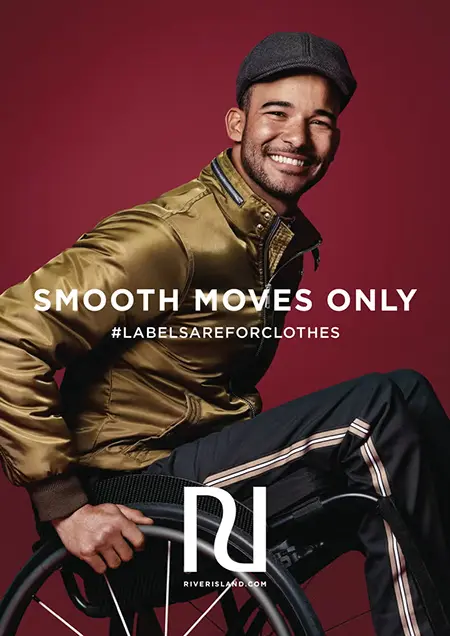
The headline could refer to his ability to move effortlessly in his wheelchair on the basketball court and in life. The target audience will also appreciate the phrase “smooth moves” suggests people will be attracted to his charisma. He does have a very photogenic and charming smile.
It is worth noting that Jordan is able to walk despite being born with pseudoarthrosis of the right tibia. Being photographed in the wheelchair shows he is embracing his disability.
His determination to succeed is inspirational. The casting choice also makes sense because he was a disability rights activist with an established cultural voice when Studio Blvd. asked him to appear in campaign. His personal values embody River Island’s message, so consumers are more likely to accept the preferred reading: labels are for clothes.
Meaning Transfer Theory
Developed by Grant McCraken (1989), the meaning transfer theory explains how advertisements produce meanings by transferring cultural values to a brand. Appling the three stages of the model can help us understand the signification process behind the River Island campaign.
Meaning Acquisition
Diversity and inclusion are two ideologically important concepts. In this pre-endorsement stage, Jordan Luce already symbolises these values because he overcame adversity to become an internationally successful athlete.
Endorsement
The marketing materials transfer the meanings we associate with the basketball player to the River Island brand. The fashion retailer now functions as a cultural symbol, strengthening its appeal to the target audience who share those views.
In terms of semiotics, the brand becomes a signifier which bonds Jordan Luce’s values to create a new sign. There is also a reverse transfer because his public profile is increased through his association with the brand. He is now a signifier of fashion.
Consumption
At the post-endorsement stage, consumers internalise the cultural symbols and shop at River Island to reinforce their personal identity.
Consumption has become a cultural process and a form of self-expression. We are no longer buying clothes. We are buying lifestyles.
Consumer Trust
This form of marketing only works if the consumer has confidence in the brand’s intentions and ability to follow through on their promises. Actions speak louder than words. That’s why River Island partnered with the anti-bullying charity Ditch the Label to create a limited-edition range of t-shirts and jumpers. £3 from every sale under the slogan went directly to the charity.
A Postmodernist Reading
The Labels are for Clothes campaign is a good example of how the function of a product is less important than its symbolic value. A racer neck jacket and skinny fit trousers are signifiers of identity rather than just something to wear.
Jean Baudrillard (1994) argued we were living in a new world of hyperreality where media simulations felt more real than the “real” world. It is easier to relate to Jordan’s story than a company slogan and River Island’s message of diversity feels more authentic than the actual experience of the clothes.
We expect brands to communicate their position on socio-cultural issues, and we will buy from companies that reflect our own personal values. We consume labels. Not clothes.
Final Thoughts
The campaign subverts our expectations by challenging the fashion industry’s preference for conventional beauty standards. This is important because Jordan Luce and the other cast members are constructing positive representations of people who are often stereotyped or marginalised in mainstream media.
Our consumer culture relies on consumption. We are not going to buy a new pair of jeans if we already have a drawer full of them. The focus on values is an effective way to maintain the system because consumption feels morally justified and buying clothes becomes an act of doing good.
Dove is another good example of a brand appealing to the beliefs and aspirations of its target audience with their message of body positivity and self-acceptance.
Questions
- Explain how representations in advertising are chosen to promote the brand.
- Explain how representations in advertising can challenge stereotypes and prejudices.
- Explain how advertising reflets the recent trend of social activism.
- Explain how media language encodes values and beliefs.
- Explain how advertising relies on narratives to construct meaning.
- Explain how audiences respond to and interpret media representations in adverts.
- Explain how the combination of elements of media language influences meaning in advertising.
Bibliography
Baudrillard, Jean (1994) Simulacra and Simulation. Translated by Glaser, S.F.
McCraken, Grant (1989) Culture and Consumption.Indiana University Press.