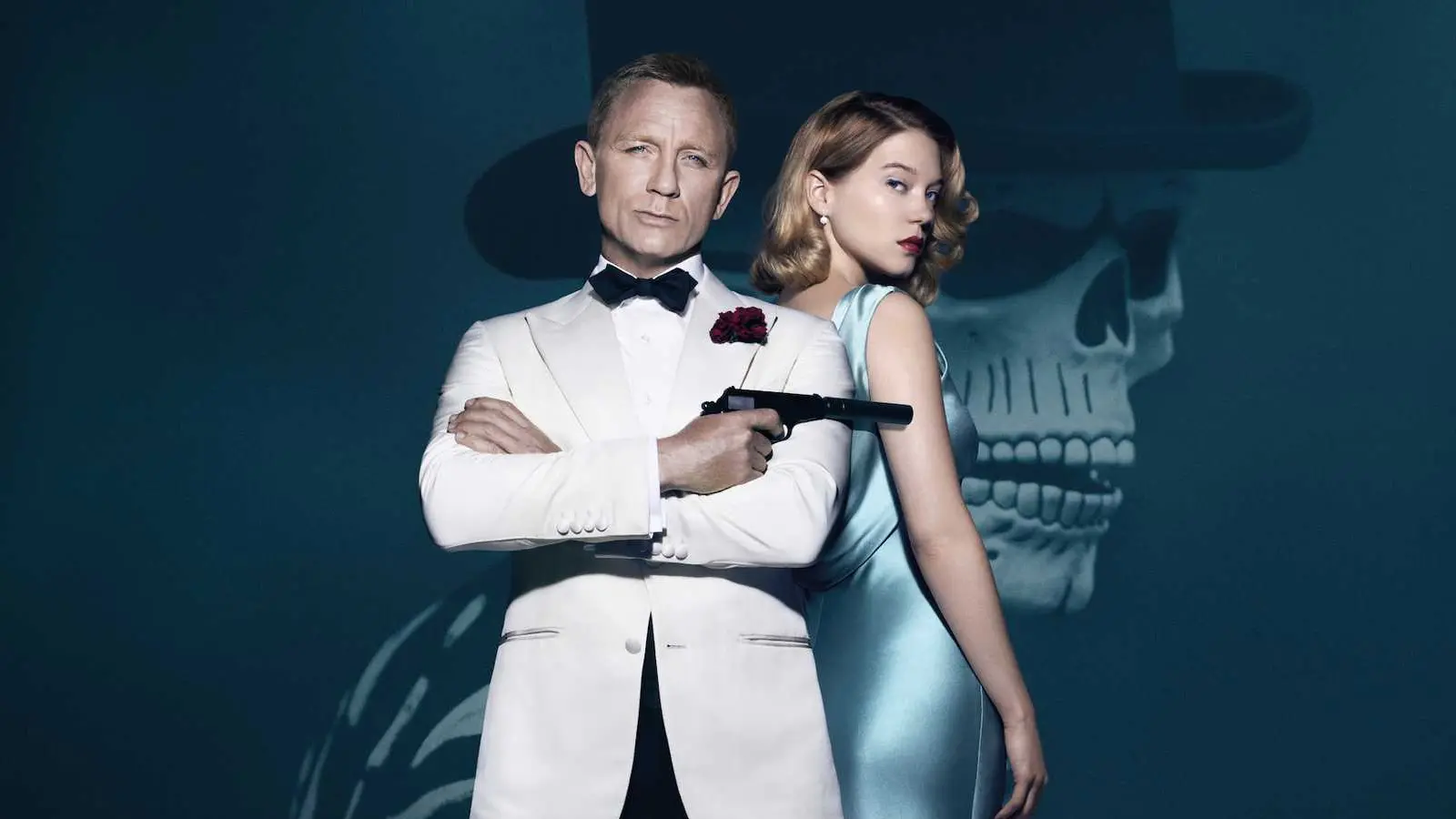
Spectre and the Representation of Women
A critical investigation into the relationship between mass culture and the audience.
Context
The #MeToo and #TimesUp movements encouraged women to come forward and share their experiences of harassment and abuse.1 Many of the attendees of the Golden Globes in 2018 showed their support and solidarity by wearing black to the ceremony.2 Some award winners used their acceptance speeches reinforce the campaigns’ messages. For example, Laura Dern said, “Many of us were taught not to tattle” and “may we teach our children that speaking out without the fear of retribution is our culture’s new North Star”.3
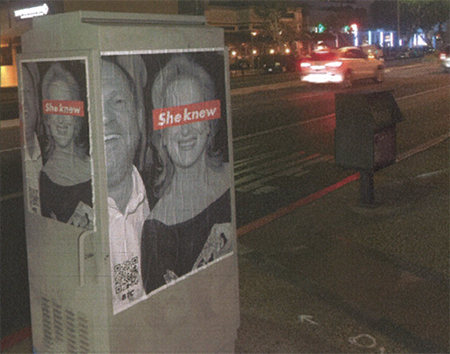
Pointing out their hypocrisy, an anonymous individual in Los Angeles posted an image of Meryl Streep posing with Harvey Weinstein.
The Independent newspaper reported that “many people have questioned whether the esteemed actor – who has worked with the disgraced Hollywood mogul on numerous occasions – knew about Weinstein’s behaviour beforehand”.4 Streep has consistently denied knowledge of any wrongdoing.
It is incredibly difficult for women to speak out because they have been marginalised by an industry controlled by patriarchal interests. Men write the scripts. Men direct the films. Men point the cameras. Men edit the footage.
Media Theory
Budd Boetticher, a director known for his low-budget Westerns in the late 1950s, commented “In herself the woman has not the slightest importance”.5 Women are simply objects in the man’s narrative. John Berger explored how mass culture positioned men as the surveyors of the text and women as the ones being surveyed. In other words, a woman’s worth is defined by her appearance. He described this succinctly as “men act and women appear”.6
Laura Mulvey coined the phrase the male gaze to describe this filmmaking system that objectifies women to satisfy male desires.7 The narrow representation is exemplified by the ridiculous “Bond girls” who are young, beautiful and easily seduced.
The Bond Girl
The original British quad poster for From Russia with Love (1963) is a notable example of how the franchise portrays women as objects to satisfy male desires.

The four women are wearing very little clothing to ensure the audience can see a lot of skin. The figure in the top left, with the direct eye contact piercing the viewer, suggests the character is sexy and seductive. She is inviting us into her space. This is a binary opposition to James Bond who dominates his space, especially with the signifier of the weapon.
Roland Barthes said “striptease is based on contradiction”. He argued a “woman is desexualised at the very moment when she is stripped naked”.8 However, this position ignores the voyeuristic pleasure of seeing the poster or the film in a darkened cinema.
The Title Sequence
Another good example of objectification is the title sequence to Spectre (2015). Monica Bellucci is naked and writhing in octopus tentacles. The title designer described the visuals as “a sort of ménage-a-trois with a couple and an octopus”.9 This is a bizarre take on a typical male fantasy, but it does reinforce the sexualisation of women and the absurd need to be dominated.
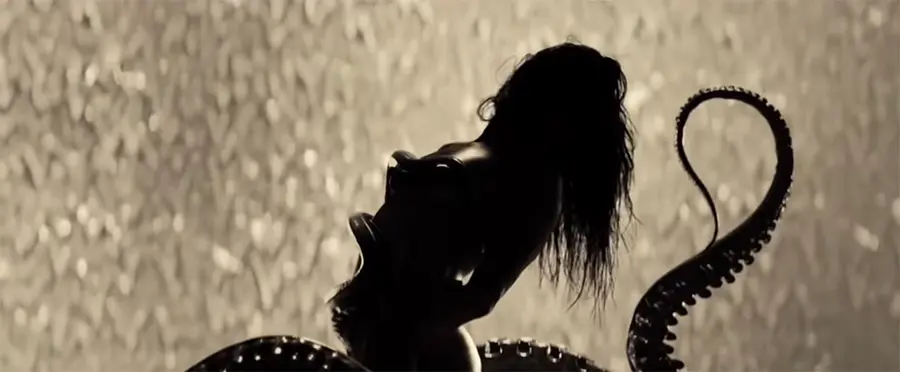
With its sinuous explosions and fire, there is a sensual feeling to the credits. Bond is dripping in naked women with close-ups showing octopi wrapping their tentacles around the bodies. Faceless, unrecognisable women fawn over Bond, playing into the stereotypically young male fantasies.
The casting of Monica Bellucci supposedly broke the traditional Bond Girl mould because of her age. The director, Sam Mendes, described the change as “revolutionary” but Daniel Craig admitted the move was not a groundbreaking change because she was fifty – the same age as Bond.10
In the film, Bond kills Lucia’s husband and then pursues the grieving and vulnerable widow when she arrives home from the funeral. She backs uncomfortably away from Bond’s advances and is forced to stop by a mirror behind her. The colour palette of this sequence of scenes becomes earthier, darker and more sinister, suggestive of the sexual tone of the scene. The instantaneous switch between her refusal and then acceptance of Bond depicts the protagonist as entirely irresistible to women. She begs him to stay for more, promoting the awful view that “no” becomes “yes” with enough persistence.
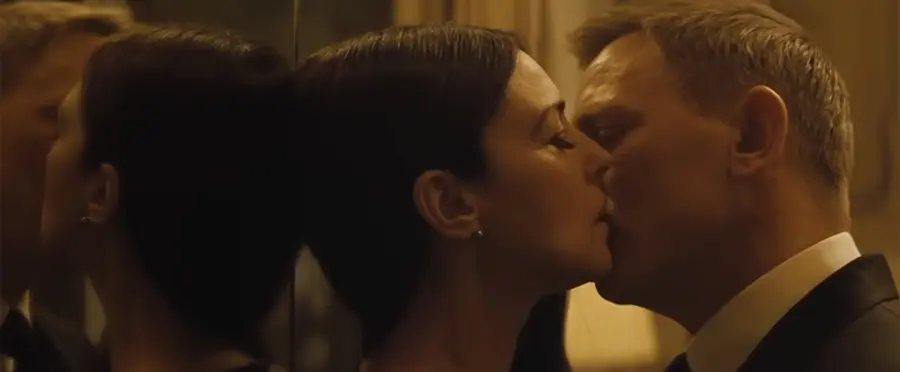
One reviewer noted “the sex scene between Bellucci’s smouldering widow and 007 is so brief, the poor chap hardly has time to unravel her basque separates”.11 Pearson went on to argue that “it’s as if the movie’s makers no longer believe in Bond the heartless womaniser but throw the encounter in to please less evolved fans”.12
Bond uses his “irresistible” charm to elicit information about the corporation controlled by her husband. Lucia is plot device rather than a woman.
In the following shot, the statuesque figure of the hero is surrounded by nameless, topless women. The use of mirroring to replicate the women almost makes them seem dispensable beside the unique and legendary Bond.

The Opening Set Piece
The opening set piece is an impressive long one-take. A masked Bond is guided by a masked woman through the crowd of people celebrating the Day of the Dead:
As they enter the elevator, this unnamed woman retrieves a key from within her dress and whispers suggestively into his ear. They enter the hotel room. Kiss once. She lies down, seductively of course, on the bed. The spectacle of her red lips draws the viewer into her space.
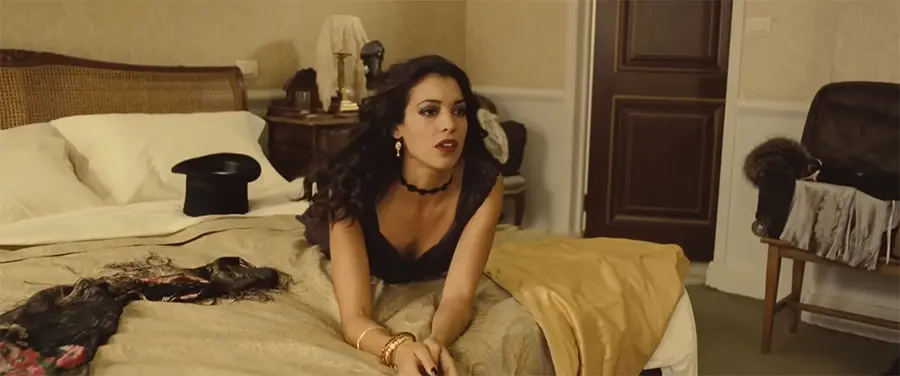
A confused expression comes upon her face as the camera pans to show a smartly dressed Bond preparing to leave. She asks, “Where are you going?”
Bond moves toward the balcony of the hotel room, responding “I’ll not be long”.
This sequence shows the first of many times Bond manipulates women to aid himself in the assassination of his enemies. Again, women are portrayed as dispensable.
Miss Moneypenny is one character who seems to offer a more positive representation of women. One critic joked, “men can fantasise about being 007, but Moneypenny’s secretarial role just isn’t so appealing”.13 Her only function in the franchise is to help Bond.
Enculturation
Roland Barthes poked fun at how mass culture naturalised the values and ideologies of the elite. He called the signification process the myth. James Bond is invariably wearing expensive watches and driving the most expensive cars. It is no surprise the protagonist is an icon of British culture, but the narrow representation of women in the series has influenced the perceptions of generations of men. When Ms Goodwin, a renowned writer and filmmaker for UK television, went to Downing Street to discuss a programme idea, she claimed a government official touched her body and remarked “you look like a Bond girl with those glasses”.14
In terms of the Harvey Weinstein case. Quentin Tarantino revealed he “knew enough to do more than I did”.15 Weinstein’s chauffeur, Mickael Chemloul, said he had to drive around “tearful aspiring actresses”.16 Since women are often represented as submissive and dependent in mass culture, such as in the Bond franchise, it is no surprise these men did not speak out against the abuse.
Measuring Inequality
Many feminist critics have tried to find ways to define this limited representation. For a film to pass the Bechdel Test, they need to:
- have at least two named women in it, who
- talk to each other, about
- something other than a man.
This very basic trial is seen as an effective indicator of patriarchal hegemony in the film industry, measuring whether or not women are dehumanised in a male-dominated plot.17 In a world where women make up 50% of the population, only 55% of 2015’s biggest movies passed the Bechdel Test.18 With 18 out of the 26 Bond films being surveyed on bechdeltest.com, only 4 passed the test.19 Spectre fails spectacularly.
Although the test often receives criticism because it does not factor in explicit sexism, objectification, or how important characters are to the story, it is a useful measure to quantify the male gaze in films.
Perhaps the Mako Mori Test is a fairer assessment of the depiction of women in film. It requires:
- at least one female character;
- who gets her own narrative arc;
- that is not about supporting a man’s story.
In Skyfall (2012), the female lead of MI6, played by Judi Dench, has a narrative about trying to keep her job and maintain control of MI6 but that character arc seems to be integrated into the main narrative of James Bond’s return to espionage and Raoul Silva’s revenge plot. She is only there to support the male protagonist, what Vladmir Propp might have defined as donor.
These tests offer a way to critically assess representations that are supposed to be positive and progressive. We need to take an oppositional gaze and evaluate how women are depicted in mass culture because these representations do influence the audience’s perceptions and behaviours.
With so much debate in media surrounding this issue, some critics worried the #metoo was a witch-hunt and the #TimesUp movement went too far. For example, Sarah Hall, a mother of a six-year-old boy in North Shields, asked for the fairy tale Sleeping Beauty to be removed from her son’s curriculum. She believed it promoted unacceptable behaviour because the princess does not give consent to be kissed.20 Do messages like this one need to be reconsidered? Many online commenters claimed Ms Hall was being overprotective, with one writing “Are you actually being serious hahaha how pathetic #world has gone mad”.21 It is worth noting the 17th Century version does include the prince raping the beautiful maiden and her birthing two children all while asleep.
Conclusion
The #MeToo and #TimesUp movements are wakeup calls.
Women will continue to be offered small and shallow roles if we don’t support people who speak out against narrow representations and an industry that appeals to the male gaze. Perhaps it is time for a new Bond. Let’s call her Jane Bond.
References
1 Germaine Greer, ‘Sex is a blood sport both sides can get hurt’, Daily Mail, 15 January 2018 (26/02/2018)
2 Lisa Respers France, LRF, ‘#MeToo: Social media flooded with personal stories of assault’, CNN, October 2017 (15/01/18)
3 Daily Mail: ‘MeToo Movement named Time Person of the Year’ (2/01/2018)
4 Brookes Barnes and Cara Buckley, ‘A Golden Globes Draped in Black Addresses #MeToo’, NY Times, January 2018 (15/01/2018)
5 Maeve McDermott, MM, “‘Big Little Lies’ stars Laura Dern, Nicole Kidman condemn abuse in Golden Globes speeches”, USATODAY, January 2018 (15/01/18)
6 http://www.independent.co.uk/arts-entertainment/meryl-streep-harvey-weinstein-she-knew-poster-campaign-la-a8119741.html
7 Quoted in Mulvey, L. (1975) “Visual Pleasure in Narrative Cinema”. Accessed: http://www.luxonline.org.uk/articles/visual_pleasure_and_narrative_cinema%28printversion%29.html
8 Berger, John (1973) Ways of Seeing.
9 This feminist theory argued that the camera lens objectified women in a voyeuristic mode for the gratification of the heterosexual, male audience, moulding the actresses into sexual objects lacking real substance or more than just a plot device.
10 Sofía Nogués, “Myths and the perception of gender in culture and society”, https://sofianogues.wordpress.com/2013/07/17/myths-and-the-perception-of-gender-in-culture-and-society/
11 Will Perkins, WP, Artofthetitle.com, February 16th 2016 (22/01/2018)
12 Hannah Furness, HF, The Telegraph, “James Bond, Master spy, philanderer, feminist, Daniel Craig speaks out”, 1st September 2015 (28/12/17)
13 http://www.telegraph.co.uk/women/womens-life/11848871/Has-James-Bond-become-a-feminist-in-SPECTRE.html
14 ditto
15 https://www.stylist.co.uk/life/feminist-watches-skyfall-james-bond-film-trailer-movie-spectre-feminism-bond-girls-monica-belluci-lea-seydoux-daniel-craig/53119
16 Paul Harper, PH, The Sun, 14th November 2017, “‘YOU LOOK LIKE A BOND GIRL’ Who is Daisy Goodwin? Victoria writer who claims she was groped inside 10 Downing Street” (15/11/2017)
17 BBC News, “Harvey Weinstein timeline: How the scandal unfolded”, 28 November 2017 (13/12/2017)
18 ditto
19 ditto
20 Kelsey Mckinney, KK, “Almost half of 2015’s top movies failed the Bechdel test”, Splinter News (10/11/2017)
21 TheBechdelTest.com, 18/26 Bond films, (18/11/2017)
22 Alex Matthews, AM, MailOnline, 23rd Nov 2017, “Mother demands her son’s school take Sleeping Beauty off the curriculum because the princess doesn’t give consent to be kissed and woken up by prince” (8/12/2017)
23 ditto